Tenders Maintenance


Tenders Maintenance allows you to setup and maintain the list of tenders allowed on your GoPOS systems.


The maintenance screen is divided into the following three sections:


Maintenance Grid

The grid area displays the currently defined discounts. All fields are display-only and all modifications to discounts must be done by selecting the row and modifying the fields in the data entry section. Once the focus is within the grid area, you may use the arrow-up and arrow-down keys to navigate through each of the rows. All values for the selected item will be displayed dynamically in the data entry section.


Select All

Clicking on the upper left corner of the grid will select all tenders. To select multiple contiguous rows, select the first row then press down the SHIFT key on your keyboard and while the SHIFT key is pressed, select the last row in your range. To select multiple rows that are not contiguous, select the first row then press down the CTRL key on your keyboard and while the the CTRL key is pressed, select each subsequent rows that you want to include in the selection. Once you are done selecting all your rows, you can release the CTRL key. All data edits or option changes will be applied to all selected rows. Pressing on the Delete button while in multi-select mode will delete all selected tenders.

Item Row Maintenance

Right clicking on any of the row numbers will display a pop-up menu that will allow you Delete, Insert or Duplicate a row. Rows may also be deleted, inserted or duplicated by using the delete, insert or duplicate buttons in the buttons area.

Column Sort

Clicking on a column header will sort the rows either in ascending or descending order, A small arrow at the top of the column will point up for ascending or down for descending order.


Data Entry

The data entry area dynamically displays the currently selected tender.


Tender Id

Enter a unique integer value to identify the tender. Required field. Duplicates not allowed. When modifying Tender Ids, a warning message will be displayed indicating that any references to the tender will be lost when the changes are saved.

Prefix

Enter the tender prefix to be displayed and printed.

Caption

Enter the tender display name. Required field. Max 25 characters.

Options

Select one or more of the following tender options:


Open Cash Drawer 1

Will open Cash Drawer 1 when this tender is used and this option is enabled or the User Open Cash Drawer 1 option is enabled.

Open Cash Drawer 2

Will open Cash Drawer 2 when this tender is used and this option is enabled or the User Open Cash Drawer 2 option is enabled.

Entry Compulsory

Select this option when an amount is required to tender the transaction. If this option is enabled and a tendered amount is not entered before pressing the tender key an "Entry compulsory" message will appear. The user must enter an amount greater than or equal to the amount due before pressing the tender key. If the amount entered is insufficient to cover the total cost, a new total will be displayed showing the word "Short" and the remaining amount due. If the amount entered exceeds the total cost, the word "Change" will be displayed with the change amount owed to the customer. If overtender is not allowed, a "Entry too high" message will be displayed and the user must re-enter the amount tendered.

Manager Required

Select this option if the user requires managerial rights. If the user does not have managerial rights, pressing the tender key will display a "Manager Required" message. Managerial override may be accessed by pressing the USR key and temporarily logging in as a user with managerial rights. "Mo" will be displayed at the top of the register to indicate managerial override mode. The register will return to regular mode once the entry has been completed or the CLEAR key has been pressed.

Tip Prompt

Select this option to enable a tip prompt. When enabled, GoPOS will send a command to the payment terminal (Pax or Datacap), prompting the customer for a tip.

No Sale Function

Select this option to open the selected cash register drawer or drawers without a sale. Open Cash Drawer 1, Open Cash Drawer 2 or both of these options must be enabled for the specified cash drawer to open. The key may be pressed at any time without affecting the current transaction.

Requires Cash Declaration

Select this option if a cash declaration is required for this currency. On GoPOS pressing the Cash Declaration fixed function key will display the list of Tenders that require cash declarations. Enter the amount followed by the times key (X) and the denomination, then press the Tender. If Setting 95 - Use Enhanced Cash Declaration is enabled, GoPOS will display a dialogue with all defined currency denominations. This will speed up the cash declaration and minimize entry errors by allowing the user to simply enter the quantity of each denomination. Once all amounts and denominations for all tenders have been declared, pressing the "Finish cash declaration" button will calculate the total declared and print a receipt.When Setting 45 - Cash declaration mandatory for clerks report is enabled, each tender with this option enabled must be declared before the clerk will be allowed to print the clerk report. Attempting to print the report before declaring will display a "Mandatory Cash Declaration" message. The clerk report will include the amount declared for each Tender as well as the calculate difference between tendered and declared.

Rounding

Select this option if the total transaction amount should be rounded. The type of rounding performed will be based on Setting 53 - "Cash Rounding".

Ask for a number entry

When using this Tender, a pop up window will be displayed to allow the clerk to enter a reference number used to identify the payment.

Overtender Not Allowed

Select this option if the amount tendered can not exceed the amount due. If the amount tendered exceeds the total due, a "Entry too high" message is displayed and the user must re-enter the amount tendered.

Food Stamp

Select this option if the tender can be used to purchase food stamp products. Using this tender will subtotal all Food Stamp items without tax when tendering the transaction. If a valid payment terminal is linked to the Tender, GoPOS will attempt to authorize and process the transaction. If the transaction amount is greater than the customer's online balance, the remaining transaction amount will be added to the non-food stamp balance and will be taxable. Over-tendering is not allowed.

Use Tender Adjustment

Enabling this option will trigger GoPOS to automatically calculate and apply a tender adjustment when this tender is used in a transaction. The Tender adjustment is defined in Setting 73 - Tender Discount/Surcharge by selecting one of the discounts or surcharges defined in Discounts Maintenance.

Credit

Enable this option to define the selected tender as the Credit tender if a valid payment terminal is defined for the APOS.

Get a Pre-Authorization

Enabling this option will trigger GoPOS to request a pre-authorization from the EFT if a valid payment terminal is defined for the APOS. A tender may be used for only one of Pre-Authorization, Completion or Void.

Complete a Pre-Authorization

Enabling this option will trigger GoPOS to request a transaction completion from the EFT if a valid payment terminal is defined for the APOS. A tender may be used for only one of Pre-Authorization, Completion or Void.

Void a Pre-Authorization

Enabling this option will trigger GoPOS to request a transaction void from the EFT if a valid payment terminal is defined for the APOS. A tender may be used for only one of Pre-Authorization, Completion or Void.

EBT Cash

Enabling this option will define the selected tender as the EBT Cash tender and can be used to purchase food stamp products. Using this tender will subtotal all Food Stamp items without tax when tendering the transaction. If a valid payment terminal is defined for the APOS, GoPOS will attempt to authorize and process the transaction. If the transaction amount is greater than the customer's online balance, the remaining transaction amount will be added to the non-food stamp balance and will be taxable. Over-tendering is not allowed, but a cash advance can be requested on GoPOS, which will send a cash advance request to the linked EFT.

Check Balance

Enabling this option will trigger GoPOS to request a Check Balance transaction from Pax and DC-Direct payment terminals. If a valid terminal is defined for the APOS, this tender will provide clients with their Food Stamp or EBT Cash account balances.


Print On

All printers defined in the hardware maintenance screen will be displayed. Select one or more of the listed printers for the chosen tender. At least one printer must be chosen.

Print Font

Select one of the supported printer fonts.


Font A Standard


Font A Double Width

Font A Double Height

Font A Double Width and Double Height        

Font B Standard

Font B Double Width

Font B Double Height

Font B Double Width and Double Height

EFT

Select "None" if no EFT is linked to the Tender or select "Use EFT Device" if the tender should be linked to a payment terminal. When "Use EFT Device" is chosen, each APOS in your network should be linked to a valid payment terminal defined in Hardware maintenance. Using this tender will trigger GoPOS to use the first payment terminal linked to the APOS device. If no EFT device is found, a warning message will be displayed on GoPOS.


For Caribbean countries, all payment terminals defined in the hardware maintenance screen will be displayed. Select one of the listed payment terminals to link the tender directly to the specific EFT.


Additional Merchant Copy receipts may be printed if Setting 62 - Print Merchant Copy has been enabled. Clicking on the Hardware Maintenance button will give you quick access to the Hardware Maintenance module.

Endorsements

All endorsement messages defined in the endorsements maintenance screen will be displayed. Select one or more of the listed endorsements for the chosen tender. The message lines defined for the endorsement will be printed at the bottom of the receipt whenever this Tender is used. Clicking on the Endorsements Maintenance button will give you quick access to the Endorsements Maintenance module.

Foreign Currency

Select this option if the tender is a foreign currency. A data entry sub section will appear allowing you to further define the foreign currency tender options.


Rate

Enter the foreign currency exchange rate.

Number of Decimals

Enter the number of decimals defined after the decimal separator.

Options

Select one or more of the following foreign currency options.


Multiply by Rate          Select this option if the conversion rate should be multiplied.


Print Conversion Rate          Select this option if the conversion rate should be printed on the receipt.

Tender ID for Change (Whole Numbers)

Select “This” if the same tender should be used when calculating whole numbers or select one of the other defined tenders.

Tender ID for Change (Fractions)

Select “This” if the same tender should be used when calculating fractions or select one of the other defined tenders.


Buttons

The buttons area consists of the following 5 buttons:


Delete

Click on this button to delete the currently selected row or rows. A warning message will be displayed indicating that any references to the deleted tender or tenders will be lost when the changes are saved.

Insert

Click on this button to insert a new row at the end of the list. All validation errors on the current row must be corrected before inserting a new row.

Duplicate

Click on this button to duplicate the currently selected row. All validation errors on the current row must be corrected before duplicating the row.

Save

Click on this button to save changes. All validation errors must be corrected before saving your changes. The button will not be enabled until a change has been made.

Close

Click on this button to close the window. If any changes have been made you will be prompted to save the changes before closing the window.


Yes Button

Click on Yes to save changes and close the window. All validation errors must be corrected before saving your changes.

No Button

Click on No to discard all changes made and close the window.

Cancel Button

Click on Cancel to abort the close and return to the maintenance screen.

Import

Click on this button to import one or more tenders from an OSI Tenders Export file (*.ten) or from a delimiter separated file (*.csv, *.txt). Using the Open dialogue window, select the file extension (*.ten, *.csv, *.txt) from the drop down list to the right of the File name and navigate to and select the file you wish to import.


If a valid OSI Tenders Export file (*.ten) was selected, clicking on the Open button will insert the tender records contained in the export file into your database.


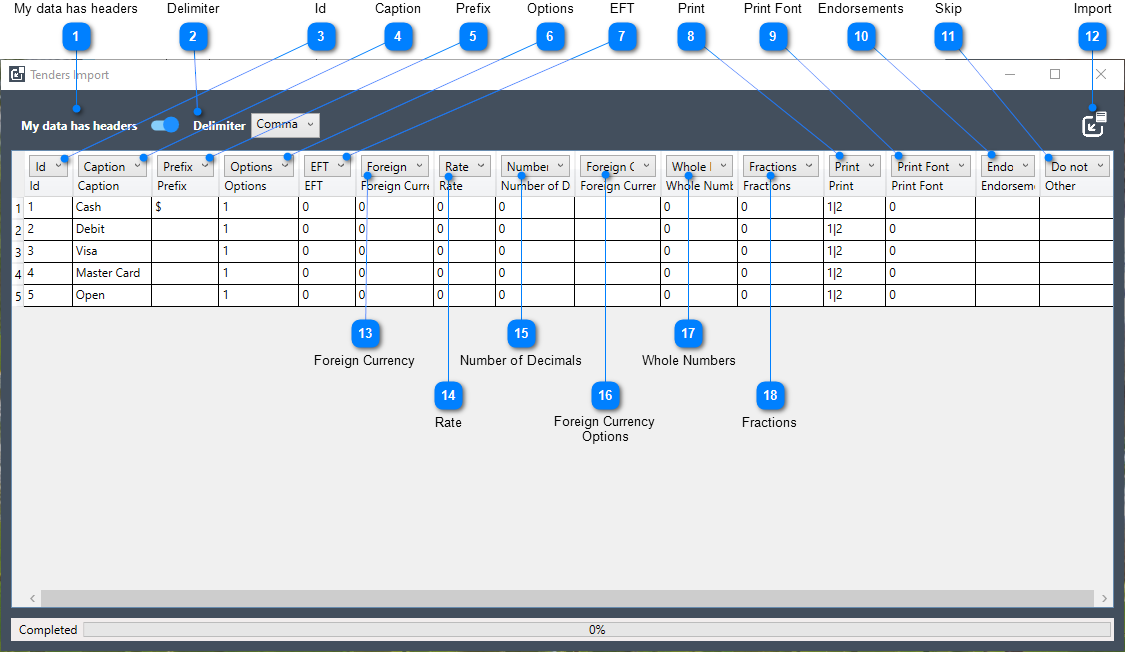
If a delimiter separated file (*.csv, *.txt) was selected, clicking on the Open button will allow you to map the data contained in the file to valid tender columns.


Determine if your data contains headers and specify the delimiter used to separate each field. Map each of the data columns you wish to import. Define all columns in your data that you do not wish to import as "Do not import (Skip)" or alternatively, remove these columns in Microsoft Excel or similar application prior to the import. Click on the Import button to import the file into your database.


My data has headers

Enable this option if your data contains data headers for each column. If the file does not contains data headers, a generic "Column X" will be displayed as the column headers. Please note that changing this option will force you to redefine the mapping of all data columns.

Delimiter

Select one of the predefined delimiter values from the drop down list. The application will parse out the fields contained in the file and attempt to display the data using the specified delimiter. Please note that changing this option will force you to redefine the mapping of all data columns.

Id

Mapping a data column to the Tender Id will verify the data to ensure that all fields are valid numeric integers without any duplicates. If the Tender Id column has been mapped, any records in the database matching the specified Tender Id will be updated. If no match is found in the database, the Tender Id and associated data will be inserted as a new record in the database. All data errors will be displayed identifying the row, column, value and error message. All records with data errors must be corrected before importing, otherwise the row or rows with errors will be skipped.

Caption

Mapping a data column to the Caption is required and will verify that all fields are valid, non blank, text values. All data errors will be displayed identifying the row, column, value and error message. If the value exceeds the maximum length of 25 characters, the value will be truncated. All other data errors must be corrected before importing, otherwise the row or rows with errors will be skipped. The Import button will remain disabled until a Caption field has been mapped and all data columns have been defined.

Prefix

Mapping a data column to the Prefix will verify that all fields are valid text values. Blanks are allowed. All data errors will be displayed identifying the row, column, value and error message. If the value exceeds the maximum length of 25 characters, the value will be truncated. All other data errors must be corrected before importing, otherwise the row or rows with errors will be skipped.

Options

Mapping a data column to Options will verify the data to ensure that all fields are valid pipe "|" delimited Integer values corresponding to individual tender options.


1          Open Cash Drawer 1

2          Open Cash Drawer 2

3          Entry Compulsory

4          Manager Required

6          No Sale Function

7          Requires Cash Declaration

8          Rounding

10          Overtender Not Allowed

11          Food Stamps

12          Use Tender Adjustment


All data errors will be displayed identifying the row, column, value and error message. All records with data errors must be corrected before importing, otherwise the row or rows with errors will be skipped.

EFT

Mapping a data column to EFT will verify that all fields are a valid numeric integer values corresponding to an existing payment terminal in hardware maintenance. All data errors will be displayed identifying the row, column, value and error message. All records with data errors must be corrected before importing, otherwise the row or rows with errors will be skipped.

Print

Mapping a data column to the Print will verify that all fields are valid pipe "|" delimited integer values corresponding to an existing printer or customer display in hardware maintenance. All data errors will be displayed identifying the row, column, value and error message. All records with data errors must be corrected before importing, otherwise the row or rows with errors will be skipped.

Print Font

Mapping a data column to the Print Font will verify the data to ensure that all fields are valid numeric integers from 0 to 7. All data errors will be displayed identifying the row, column, value and error message. All records with data errors must be corrected before importing, otherwise the row or rows with errors will be skipped.


0          Font A Standard

1          Font A Double Width

2          Font A Double Height

3          Font A Double Width and Double Height

4          Font B Standard

5          Font B Double Width

6          Font B Double Height

7          Font B Double Width and Height

Endorsements

Mapping a data column to Endorsements will verify that all fields are valid pipe "|" delimited integer values corresponding to an existing endorsement in Endorsements Maintenance. All data errors will be displayed identifying the row, column, value and error message. All records with data errors must be corrected before importing, otherwise the row or rows with errors will be skipped.

Skip

Mapping a data column to Do not import (Skip) will ignore the data in the specified column. Please note that the Import button will remain disabled until all data columns have been mapped or set to skip.

Import

Once a Caption field and all data columns have been mapped or set to Skip, the Import button will be enabled. Clicking on this button will update or insert all valid records into the database. All data errors will be displayed identifying the row, column, value and error message.

Foreign Currency

Mapping a data column to Foreign Currency will verify the data to ensure that all fields are valid boolean integers (0 = False, 1 = True). All data errors will be displayed identifying the row, column, value and error message. All records with data errors must be corrected before importing, otherwise the row or rows with errors will be skipped.

Rate

Mapping a data column to Rate will verify the data to ensure that all fields are valid 5 digit integer values. Blanks are allowed. The integer value will be converted to a Foreign Currency rate with 5 decimal places. All data errors will be displayed identifying the row, column, value and error message. All records with data errors must be corrected before importing, otherwise the row or rows with errors will be skipped.

Number of Decimals

Mapping a data column to the Number of Decimals will verify the data to ensure that all fields are valid numeric integers from 0 to 5. All data errors will be displayed identifying the row, column, value and error message. All records with data errors must be corrected before importing, otherwise the row or rows with errors will be skipped.

Foreign Currency Options

Mapping a data column to Foreign Currency Options will verify the data to ensure that all fields are valid pipe "|" delimited Integer values corresponding to individual foreign currency options.


1          Multiply By Rate

2          Print Conversion Rate


All data errors will be displayed identifying the row, column, value and error message. All records with data errors must be corrected before importing, otherwise the row or rows with errors will be skipped.

Whole Numbers

Mapping a data column Whole Numbers will verify that all fields are a valid numeric integer values corresponding to an existing Tender Id or 0 to indicate "This" tender. Blanks are allowed. All data errors will be displayed identifying the row, column, value and error message. All records with data errors must be corrected before importing, otherwise the row or rows with errors will be skipped.

Fractions

Mapping a data column Fractions will verify that all fields are a valid numeric integer values corresponding to an existing Tender Id or 0 to indicate "This" tender. Blanks are allowed. All data errors will be displayed identifying the row, column, value and error message. All records with data errors must be corrected before importing, otherwise the row or rows with errors will be skipped.


Export

Click on this button to open the Export window which will allow you to export the tender list to an OSI proprietary export file (*.ten) or to a delimiter separated file (*.csv)


Export Type

Select one of the following export types:


OSI Proprietary

Select the row or rows you wish to include in the export file. Click on the Export button to open the Export window which will allow you to export the selected tenders to an OSI proprietary export file (*.ten).

CSV Delimited

Select CSV Delimited to export all tenders to a delimiter separated file (*.csv). Determine if you want to include column headers and choose one of the supported delimiters. Click on the Export button to open the Export window which will allow you to export all tenders to a delimiter separated file (*.csv).


Include Headers

Select this option if you want to include column names in your export file.

Delimiter

Select one of the supported delimiters to be used to separate each of the columns in your csv export file.

Export

Click on this button to open the "Save As" dialogue window and export the selected tenders to an OSI proprietary export file (*.ten) or all tenders to a delimiter separated file (*.csv).


The name of the export file will be defaulted based on export type and selections made, but may be changed to a file name of your choice.


Please note that the OSI proprietary format is meant to allow you to export elements from one PcProg program to another without the need to map your column data. If you want to view or edit the data contained in the export file, you must choose to export a delimiter separated file. To edit your *.csv file, it is best to open Microsoft Excel and use the Open dialogue to navigate to the export file and select Text Files (*.prn, *.txt, *.csv) in the drop down next to File name. This will open the Microsoft Text Import Wizard, which will allow you to tell Microsoft Excel what delimiter was used, whether your data has headers or not, and how to map the data format of each of the columns.  Any changes made to the file within Excel should also be "Saved As" a csv file if you intend on re-importing these changes back into PcProg.